yournrd
calendar


Click for Sidney, NE Weather

Click for Sidney, Nebraska Forecast

nerain_logoThe Nebraska Rainfall Assessment and Information Network (NeRAIN) collects rainfall information all across Nebraska. Click logo to see rain reports.

The network needs volunteers to collect and report rainfall amounts. To participate, e-mail NeRAIN Coordinator Chris Kaiser or call him at (308) 254-2377.

Many SPNRD projects and programs are made possible thanks to Nebraska Environmental Trust grants. To learn more about NET's comittment to Nebraska's natural resources, click here.

The South Platte NRD Board of Directors is a group of locally elected officials managing area natural resources on your behalf. The board meets the second Tuesday of each month and welcomes your input.

The next scheduled board meeting is:
Tuesday, June 11
5:00 p.m. at the District Office, 551 Parkland Dr. in Sidney.
Click here to see board agendas and minutes.

facebook

barrier_cdThe SPNRD recently posted a video on YouTube, offering potential solutions to help landowners and tree professionals relieve fabric girdling in conservation tree plantings. To access the video, use the link:
http://youtu.be/HgFl9uJAGAQ


                                                           Public Notices

The meetings of the various boards, committees and advisory groups performing their functions on behalf of the South Platte Natural Resources District are meetings where business is discussed in open session, except where provided by state law. The District Board of Directors encourages members of the public to attend such meetings and provide input as to the management of natural resources in the southern Panhandle.

To see current meeting notices, click here.


Scholarships Available For Student Camps

The District has two scholarship opportunities for students wishing to attend one of two camps focusing on natural resources education this summer.

The scholarships are for high school students attending Range Camp, while middle school students (sixth to eighth grades) are eligible for ACE (Adventure Camp about the Environment) Camp. Click here to read more and for links to packets including brochures, registrations and scholarship applications.


RainBarrel

New Practices Add Beauty, Function and Protection to Landscape

The District has added two new practices to cost share programs focusing on solutions for urban homeowners. The new programs focus on protecting ground water and program coordinator Ryan Reisdorff says each provides a singular advantage. Click here to read more.


                      Irrigator Management Requirements Relaxed For South Platte Valley

Irrigators in southeast Deuel County will have fewer management requirements to abide by beginning in 2013, following a change approved by the South Platte NRD board of directors at its February meeting.

The change results from lower nitrate/nitrogen levels found through the District’s monitoring program, which showed that for the third consecutive year, nitrate/nitrogen averaged below 8 parts-per-million (ppm) in the South Platte Valley Ground Water Quality Management Are
a. Click here to read more.


UNL Drought Managment Website Provides Information

UNL_Drought2012 will be a year we all remember due to the drought related hardships for many families, communities, farms and ranches.  And the history of drought in Nebraska as well as the forecasts for the next several months suggests that this drought may not be a single year event.

UNL Extension has a faculty team assisting Nebraskans with many difficult decisions resulting from drought such as alternative feed supplies, managing higher food costs, and reducing water use in agriculture and urban green space. US Senator Mike Johanns was briefed by representatives of this team on the drought earlier this year. “We had some of the best people in the university system around the table giving me this briefing,” Johanns said. “And I was so pleased by the quality of the people that were there in their understanding of row crop problems, range problems, just the whole gamut of drought issues, and I think whatever we can do to support those people and build that capacity will pay huge, huge dividends for our state in the future.”

To see the information UNL has developed for management in drought, click here.


NRD Sponsored Project Focuses On ET

The board was recently updated on a project funded through the District in conjunction with the Upper Niobrara White and North Platte NRDs and the Nebraska Department of Natural Resources.

Gary Stone, from the UNL Panhandle Research and Extension Center at Scottsbluff, presented year-two numbers from a three-year Panhandle-wide study on evapotranspiration (ET) and use of atmometers to measure crop water use.

Even knowing the hot dry conditions would result in greater water use, Stone and others were surprised by the 2012 crop year’s final numbers, which showed crops required an average of 2.25 inches more water per week over 2011. Cumulatively, that added up to 12 inches more water requirement over the previous season.

Stone reported in the region, some areas showed up to four inches of water demand in a single week. He said on average, the further west and south one went in the District, the higher the evapotranspiration. Click here to see more about the ET Project. See a PDF of the Project Report.

In a second report from the Research and Extension Center, Stone and Dr. Gary Hergert provided a short introduction to a new Excel-based program, Water Optimizer, developed by the University.

The program comes from studies done in deficit irrigation to assist agricultural producers determine potential crops, populations, water needs and other factors when full irrigation is not possible.

“Deficit irrigation changes the entire irrigation picture and practices,” Hergert said. “Relationships between yield, ET and water pumped change drastically from the irrigation curves under full irrigation.”

Hergert said the wide swings in precipitation in recent years are likely to continue and water management will become more critical. Hergert said examples of those drastic changes show in 2005, one of the wettest years in the past 100 years; followed by 2007 and 2012, which were two of the century’s driest.

The University and Panhandle NRDs plan to work together on meetings that will showcase Water Optimizer, display its capabilities and help producers learn how to use it as a management tool. For more information on Water Optimizer, click here.


Helicopter Scans Provide New Look At Geology -- Report Available

When the first Helicopter Electromagnetic (HEM) system took flight over the South Platte NRD in June of 2008, it was a relatively new concept in exploring Nebraska’s water formations. Test flights had been performed in the eastern part of the state, but in the west, with widely varying formations at vastly different depths – capabilities were still an unknown.

A number of flights, both contracted and flown as free demonstrations of companies’ capabilities, have traversed parts of the District.
For more on the project background, click here.

The Final Report is available in PDF form.


Changes To Districtwide Rules and Regulations Include Allocation Adjustments

Allocations of ground water used for irrigation will change in some areas beginning in the 2013 growing season following a change in the South Platte Natural Resources District’s (SPNRD) rules and regulations.

The District board of directors voted 6-1 to make the changes at its regular March meeting. The decision was made following months of review and meetings, including a public hearing that preceded the board meeting.  (Click here to read more)


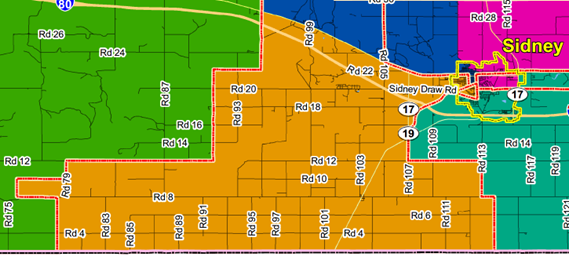
Director Subdistricts Change Due To Population Shifts

Changes to South Platte NRD Director Subdistricts will have constituents in some areas represented by different directors.

The changes are a result of realignments due to population shifts, documented by the 2010 census. By law, representative subdistricts can have no more than a 10 percent variation between the most and least populated areas. The optimum target is a 1:1 ratio.

Cheyenne County, mostly the Sidney area, grew from 2000 to 2010, while populations in Kimball and Deuel County declined. The population shift resulted in a 34 percent variance between SPNRD Subdistrict 5, which covers southeast Sidney and Cheyenne County,  and Subdistrict 2, the east side if Kimball and Kimball County and a sliver of western Cheyenne County.

The biggest change in bringing subdistricts’ representative population into alignment was to move the Subdistrict 2 eastern boundary. Previously, Potter had been split between Subdistricts 2 and 4, but now lies wholly within Subdistrict 2.

Most other changes made to balance subdistrict populations were made with slight shifts within Kimball and Sidney. With the realignments, the variance between the largest and smallest subdistricts is seven percent.

Directors and their subdistricts are: SubDistrict 1 – Bill Halligan of Bushnell; Subdistrict 2 – James Johnson of Dix; Subdistrict 3 – Timothy Maas of rural Potter; Subdistrict 4 – Paul Hutchison of rural Sidney; Subdistrict 5 – Kieth Rexroth of Sidney; Subdistrict 6 – Tom Biggs of rural Sidney; and Subdistrict 7 – Larry Rutt of rural Chappell. (Click here to see the new subdistrict map)


NARD Conservation Tree Booklet Updated

To further assist you with your conservation tree purchase, the Nebraska Association of Resources Districts (NARD) and Nebraska’s Natural Resources Districts (NRDs) has published the popular and widely distributed Conservation Trees for Nebraska booklet. In it, tree species are represented with excellent color photos (tree aspect and foliageTree Book close ups). Descriptions of the tree’s notable features, disease vulnerabilities, and vegetative growing zone information are also included. The 58 page booklet also contains information on weed barrier and control, drip systems, and reference maps to all 23 NRDs and Nebraska Forest Service Districts.

Many species are included in the edition, including as Black Hills Spruce, Southwestern White Pine, Harbin Pear, Northern Catalpa, Pecan, American Hazelnut and many more. A total of 47 species are featured. The booklet also features a quick reference table to all species described within.

Planted properly in appropriate locations, conservation trees protect newborn calves, protect soils, save water, save energy, and provide habitat for wildlife.

Booklets are available at your NRD Office, your nearest NRCS Field Office and UNL Extension offices in Chappell, Kimball and Sidney. It is also available online at http://www.nrdtrees.org/. The booklet is also available as an app for both Apple and Android smart phones. Links are on the nrdtrees site.


EconomicReport
Click image to see full report

Board Looks At Economic Impact

Among the tools used by the South Platte Natural Resources District board of directorsis a report outlining possible affects of District actions on the area’s economy.

The report, entitled “The Economic Impact of the South Platte NRD’s Integrated Management Plan and Districtwide Ground Water Management Area Rules and Regulations,” was commissioned by the District to see what affects its regulations might have.


SPNRD Multi-Jurisdictional Hazard Mitigation Plan In Effect

The District-led Multijurisdicational Hazard Mitigation Plan is now in effect, opening the door to participating entities which have needs protecting residents in the event of natural disasters.

Under the Disaster Management Act of 2000, local entities are required to form a Hazard Mitigation Plan to take action before a disaster occurs to reduce or eliminate threats. (Click here to read more)


Platte Basin-Wide Water Management Progress Reviewed

Officials from Platte Basin Natural Resources Districts (NRDs) and the Nebraska Department of Natural Resources (DNR) met for a review of the Basin-wide Plan for Joint Integrated Water Resources Management of the Overappropriated Portion of the Platte River Basin, Nebraska. (Click here to read more)


Program Provides Options To Preserve Area’s Grassland Cover

With the potential expiration of contracts protecting more than 260,000 acres of Conservation Reserve Program (CRP) land in the Panhandle by 2013, Panhandle natural resources districts and the Natural Resources Conservation Service have teamed together to preserve regional grassland cover. (Click here to read more)


WANTED: Local weather watchers for NeRAIN

Volunteers are needed in Cheyenne, Deuel and Kimball counties to volunteer for a special project for studying the complex patterns of rain, hail and snow in Nebraska.

NeRAIN, (the Nebraska Rainfall Assessment and Information Network) is looking for volunteers – preferably with Internet access -- willing to report measurements of precipitation using high quality backyard rain gauges. (Click here to read more)


Citizens' Group Monitors Environmental Impact

In keeping with its mission to protect and manage natural recources, one activity the District is involved with is the Citizen’s Monitoring Committee (CMC) at Kimball.

The local group, established by the South Platte NRD and the Kimball community, monitors the environmental impact of operations at Clean Harbors Environmental Services, Inc. (CHESI). (Click here to read more)